Today in Mrs. Jones' class, students built catapults using spoons, tongue depressors, and rubber bands! They were investigating how the placement of the fulcrum effects distance. All students were so engaged and had to draw a diagram of their catapult and give an explanation of this investigation! Love seeing STEM lessons in action -- check with Mrs. Jones and she might be able to give you a date so that you could stop by to check out some STEM lessons too!
Friday, April 15, 2016
Project Based Learning
![]() |
| Don't let this happen to your students -- check out the tips below! |
PBL is a wonderful way to increase student curiosity and creativity! During the months of April and May, it's also a nice way to keep students engaged and reinforce the skills/standards they've learned all year! According to the NEA (National Education Association),
"This model helps make learning relevant to students by establishing connections to life outside the classroom and by addressing real world issues. In the classroom, PBL gives teachers an opportunity to build relationships with students by acting as their coach, facilitator, and co-learner. In the school and beyond, the model further allows teachers opportunities to build relationships among colleagues and with those in the larger community. Student projects can be shared with other teachers, parents, and others who have a vested interest in the students' education." http://www.nea.org/tools/16963.htm
Below are some links to resources that can help you plan and implement PBL in your classroom.
Why PBL?
http://bie.org/about/why_pbl
PBL Essential Elements Checklist
(For teacher planning phase)
http://www.educatorstechnology.com/2013/03/a-great-project-based-learning.html
Twenty Tips for Managing Project-Based Learning
(My favorite tip: #15 - Give Useful and Accessible Feedback)
http://www.edutopia.org/blog/20-tips-pbl-project-based-learning-educators-andrew-miller
Please reach out to me if you need any help in the planning or facilitating of classroom projects -- I always love visiting when you have display days, too!!
Thursday, April 7, 2016
Shark Spotlight!
Below, one of Mrs. Swales' Kindergarten students got up from his seat and went to use the Word Wall to help him during writing! It was obvious that Mrs. Swales taught this strategy to her students -- what a wonderful way to make her Word Wall interactive and useful!
In Ms. Komisak's 5th grade classroom, the students have a Connections Wall, where they stick Stop and Jot notes with connections they have made while reading with the class, or during Independent Daily Reading. They write the connection and a small explanation! Such a cool way to build classroom culture while displaying reading comprehension through student work!
I'm so proud to be a SHARK!
Tuesday, March 1, 2016
Rigorous Centers PD Follow Up
Shoutout to Heather and Jada for co-facilitating our Rigorous Centers PD! I loved hearing the discussions in the PD, but also seeing how many wheels this PD got turning and the reflection taking place. I'd love to sit with teams to look at stations and best practices that go along with them. We can also discuss creating a community of independent learners...for now, take a look at some of the videos and resources below!
Math:
Check out the video linked below from Debbie Diller on math stations! She has a great series called "Moving into Math Stations" with videos from running stations to storing manipulatives -- definitely worth the time to watch.
https://youtu.be/xUKvXWFUd68
Here's a first grade blog sharing how this teacher structures math stations, and how she rotates them -- she even includes a reading station in her rotation for her students to read math stories/books!
http://firstgradefrogblog.blogspot.com/2012/02/build-math-centers.html
Another video of 4th grade students explaining their stations, and then working in them!
https://youtu.be/Z_vDV_UkP_0
Reading:
This blog post shares how this teacher creates task cards that can fit with any reading material and she shares links to free resources:
http://onestopteachershop.com/2014/06/no-fuss-literacy-centers.html
My favorite Teaching Channel teacher, Jenna, has amazing videos from her classroom that share how she manages, introduces, and runs her stations! Her tips can help both primary and intermediate classrooms!
https://www.teachingchannel.org/videos/introducing-reading-work-stations
Monday, February 1, 2016
Vocabulary PD Follow Up
Wow! I was impressed with the collaboration and instructional discussions that took place at our Vocabulary PD! Thank you all for your insight, questions, and positive mindsets!
This would be a great formative assessment piece before reading a text and could be adjusted for any grade level or content area!
You can read more on this through the following link to the article on edutopia:
http://www.edutopia.org/blog/vocabulary-instruction-teaching-tips-rebecca-alber
I was happy to receive many questions and requests for more activity ideas via the exit tickets. Below are a few questions with responses and I will share more activity ideas to specific grade levels in the upcoming weeks! Thank you all for jumping in whole heartedly and reflecting on your practice! We work at a great school!
________________________________________________________________________________
1. When you teach all subjects, which types of words (Tiers 1-3) are most effective for students to have in the classroom word walls?
Tier 2 words would be best for word walls -- remember Tier 1 words are words that students speak with on a daily basis. Yet, for kindergarten or first grade, sight words would be beneficial (which probably fall under Tier 1). It's always a good idea to display or make Tier 3 words available to students as well, but word walls should focus on high frequency words. Students could also have personal word walls in folders, that they keep different words than those on display on a word wall.
Here is a link to a great article/site about word walls and making them interactive!
________________________________________________________________________________
2. How do you know what words they don't know?
There is no way to know every students' vocabulary knowledge. But after working with students and conferring with them on different topics/activities, you can start to do some formative assessments. Tier 2 words are those words that can be used across contexts and are high frequency words, but that doesn't mean that they understand the meaning. Here's an idea from the article "Doing It Differently: Tips for Teaching Vocabulary":
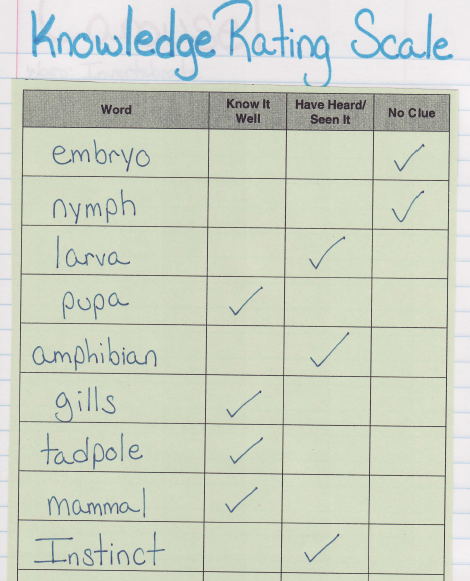
- Ask each child to create a chart where he/she writes down words of choice, and rates each one as "know it," "sort of know it," or "don't know it at all."
- Then, on the same paper, have them write a definition or "my guess on meaning" for the words they know and kind of know (No dictionaries!)
This would be a great formative assessment piece before reading a text and could be adjusted for any grade level or content area!
You can read more on this through the following link to the article on edutopia:
http://www.edutopia.org/blog/vocabulary-instruction-teaching-tips-rebecca-alber
__________________________________________________________________________________
3. What are some ideas that can be used for vocabulary notebooks?
Below are a few links to different ways to set up vocabulary notebooks, or templates to use. If you are interested in finding out more, send me an email and I will happily book a time to come and sit with you to develop something that works for you and your students!
__________________________________________________________________________________
If you've made it to the end of this long blog post, HOORAY! Thank you for taking the time to look at my follow up on vocabulary. For a chance to win a trip to my Teacher Treasure Box, post a comment with a reaction to this post, a way you've incorporated something from our Vocabulary PD, or share a vocabulary tip that you use in your classroom (you could even post a picture!). Happy posting!!
SHARK Spotlight!
Before our vocabulary PD, tiered vocabulary was spotted in Mrs. Campbell's fourth grade classroom! Check out her anchor chart below and the vocabulary that fits into each category!
Mrs. Greco and the first grade team use vocabulary folders in their classrooms to have students make visual connections with their words, and also write sentences as a class to see the words in context! Wonderful word work!
Sunday, January 10, 2016
Happy 2016 -- Upcoming PD!
Welcome back Shark fam! I'm looking forward to continuing best practices and sharing in you and your students' successes in this new year!
Are you curious yet what our Wednesday (1/13) after school PD will be focused on? Here's a sneak peak...Can't wait to see you there (Don't forget your Interactive Notebook)!

Are you curious yet what our Wednesday (1/13) after school PD will be focused on? Here's a sneak peak...Can't wait to see you there (Don't forget your Interactive Notebook)!
Subscribe to:
Posts (Atom)