Monday, February 1, 2016

Vocabulary PD Follow Up

Wow! I was impressed with the collaboration and instructional discussions that took place at our Vocabulary PD! Thank you all for your insight, questions, and positive mindsets!


I was happy to receive many questions and requests for more activity ideas via the exit tickets. Below are a few questions with responses and I will share more activity ideas to specific grade levels in the upcoming weeks! Thank you all for jumping in whole heartedly and reflecting on your practice! We work at a great school!
________________________________________________________________________________
 
1. When you teach all subjects, which types of words (Tiers 1-3) are most effective for students to have in the classroom word walls?
 
        Tier 2 words would be best for word walls -- remember Tier 1 words are words that students speak with on a daily basis. Yet, for kindergarten or first grade, sight words would be beneficial (which probably fall under Tier 1). It's always a good idea to display or make Tier 3 words available to students as well, but word walls should focus on high frequency words. Students could also have personal word walls in folders, that they keep different words than those on display on a word wall.
 
Here is a link to a great article/site about word walls and making them interactive!
 
________________________________________________________________________________
 
2. How do you know what words they don't know?
 
          There is no way to know every students' vocabulary knowledge. But after working with students and conferring with them on different topics/activities, you can start to do some formative assessments. Tier 2 words are those words that can be used across contexts and are high frequency words, but that doesn't mean that they understand the meaning. Here's an idea from the article "Doing It Differently: Tips for Teaching Vocabulary":
  • Ask each child to create a chart where he/she writes down words of choice, and rates each one as "know it," "sort of know it," or "don't know it at all."
  • Then, on the same paper, have them write a definition or "my guess on meaning" for the words they know and kind of know (No dictionaries!)
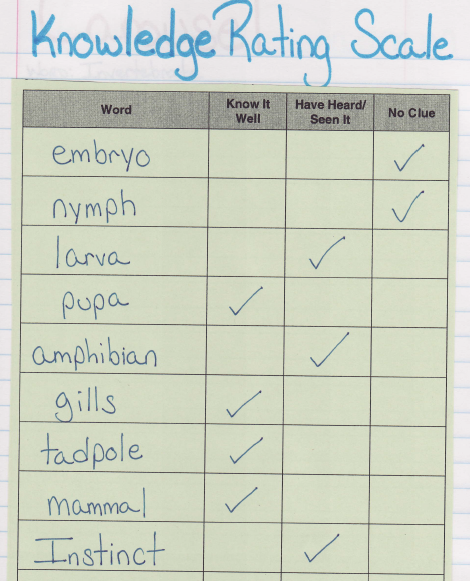
Before they turn in these pre-reading charts, be sure to emphasize this is not about "being right" but that they are providing you with information to guide next steps in class vocabulary instruction.


This would be a great formative assessment piece before reading a text and could be adjusted for any grade level or content area!

You can read more on this through the following link to the article on edutopia:
http://www.edutopia.org/blog/vocabulary-instruction-teaching-tips-rebecca-alber
__________________________________________________________________________________
 
3. What are some ideas that can be used for vocabulary notebooks?
       
        Below are a few links to different ways to set up vocabulary notebooks, or templates to use. If you are interested in finding out more, send me an email and I will happily book a time to come and sit with you to develop something that works for you and your students!


__________________________________________________________________________________
 
If you've made it to the end of this long blog post, HOORAY! Thank you for taking the time to look at my follow up on vocabulary. For a chance to win a trip to my Teacher Treasure Box, post a comment with a reaction to this post, a way you've incorporated something from our Vocabulary PD, or share a vocabulary tip that you use in your classroom (you could even post a picture!). Happy posting!!

SHARK Spotlight!

Before our vocabulary PD, tiered vocabulary was spotted in Mrs. Campbell's fourth grade classroom! Check out her anchor chart below and the vocabulary that fits into each category!


Mrs. Greco and the first grade team use vocabulary folders in their classrooms to have students make visual connections with their words, and also write sentences as a class to see the words in context! Wonderful word work!


Sunday, January 10, 2016

Happy 2016 -- Upcoming PD!

Welcome back Shark fam! I'm looking forward to continuing best practices and sharing in you and your students' successes in this new year!

Are you curious yet what our Wednesday (1/13) after school PD will be focused on? Here's a sneak peak...Can't wait to see you there (Don't forget your Interactive Notebook)!


Sunday, November 8, 2015

Shark Spotlight


Here's my first Shark Spotlight!! I will start to share great activities, anchor charts, etc. that are happening at ISNP, and I'll make sure to share where I spotted them so you can reach out to learn and share with each other!

Spotted...

A Growth Mindset anchor chart in Mrs. Hodge's class! Her students  have been working with growth mindset since the beginning of the school year!


Concrete learning happening in Mrs. Legaspi's math class in interactive math journals! So exciting to see that students are manipulating equations in this first grade classroom!


A math art activity where second graders in Ms. Fernandez's classroom had to use arrays to show their understanding!


Growth Mindset and Feedback


Perseverance Strategies students could try...


Tuesday, October 20, 2015

CRA: Sequence of Math Instruction

Thank you to all of the math teachers who attended today's roundtable discussion! It was wonderful to hear everyone generating strategies and solutions to our barriers, and sharing ideas across grade levels!

I am sharing the anchor chart from our discussion today, and I cannot wait to get into classrooms to see concrete and representational learning happening!


Don't forget about our blog challenge:

1.     Comment on my blog post how you are going to incorporate concrete learning in your next (or an upcoming) lesson.

2.     Set up a time for next week for me to come in and see concrete learning taking place in your classroom.


Also, follow my Math board on Pinterest:
https://www.pinterest.com/abrannack/mathematician/


Image result for math concrete

Happy math manipulating!!

Monday, October 12, 2015

Anchor Charts with Purpose

If you've ever searched through the education section of Pinterest, you've seen a plethora of examples of anchor charts. Some colorful and with illustrations or designs. Some with less color and more writing. We all have different styles, so regardless of how you might design an anchor chart, we all should have purposeful anchor charts. Anchor charts stand as visual anchors for student thinking based on learning happening in their classroom. They support students and should be easily referenced.

What constitutes as a purposeful anchor chart? Well, that depends on why you're making a chart, and how you plan to use it. What is the standard you are focusing on? Anchor charts can range from:

    - Introducing a skill
    - Reviewing content
    - List of class expectations
    - Interactive graphic organizer/chart for lesson
    - List of strategies for specific skill/standard
    - Enlarged rubric for writing
    - Character Expectations

These are just a few, but there are so many other ways that anchor charts can be used in the classroom!

Things to Remember:

1. Use academic language.
2. Writing should be large enough to be visible in the classroom.
3. Colorful writing can make charts more appealing to students.
4. Keep charts focused on one topic/skill/etc.